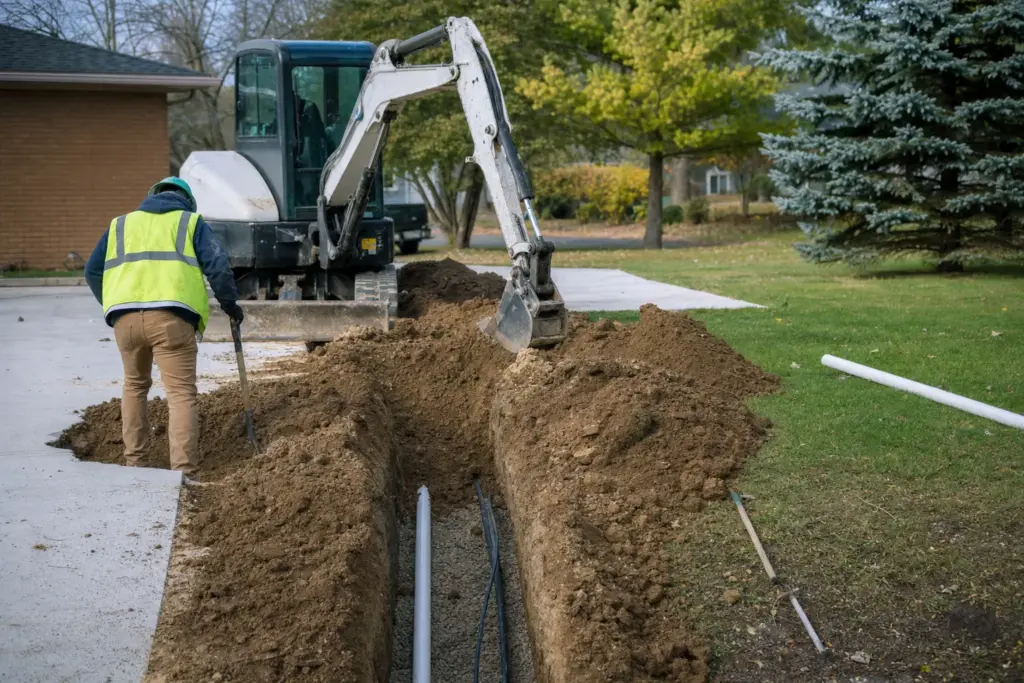
Rock Solid Excavation handles the underground work that connects a property to its services — trenching for water, electric, and gas service lines, and sewer tie-ins to municipal systems. We plan around the utilities already in the ground, dig clean, and restore the surface so you'd hardly know we were there. In Michigan, what's buried has to survive frost and shifting clay, so compaction and depth matter. Freeze, thaw, repeat — built to take it.
What We Run
From a single service line to a sewer connection, we do the trenching and tie-in work that gets a property connected, on a new build or an existing one.
- Trenching for water service lines
- Trenching for electric service lines
- Trenching for gas service lines
- Sewer tie-ins to municipal systems
- Routing around existing buried utilities
- Backfill, compaction, and surface restoration
How We Keep Disruption Down
Trenching across a finished property can be a mess if it's done carelessly. We plan the route around what's already in the ground, dig efficiently, and put the site back together — proper backfill, compaction so the trench doesn't settle and sink later, and surface restoration so the lawn or drive recovers. Doing the compaction right is what keeps a trench from turning into a sunken line across the yard after the first freeze-thaw season.
- Routes planned around existing utilities before digging
- Tight, efficient trenching to limit the footprint
- Proper backfill and compaction to prevent settling
- Surface restored when the work is done
New Builds and Existing Properties
On a new build, utility runs and the sewer tie-in get planned with the rest of the site work so everything fits — trenching gets done before the surfaces go down, and the connections are laid out to match how the rest of the site comes together. On an existing property, the challenge is working around what's already there — landscaping, drives, and other buried lines — with as little disruption as possible. Either way, John will walk the route with you first and lay out how the work will go.
Depth and Frost
In Michigan, depth isn't optional. Buried lines have to sit below the frost line and stay there, because a service line set too shallow can freeze, shift, or fail when the ground heaves. We dig to the right depth for what's being run, bed the line properly, and backfill in a way that protects it for the long haul. Freeze, thaw, repeat — built to take it. Getting the depth and bedding right up front is what keeps a buried line out of trouble for decades instead of becoming a problem after the first hard winter.
- Lines set below the frost line
- Proper bedding to protect the service
- Backfill and compaction that hold up through freeze-thaw
- Routes and depths planned for the specific line being run
Frequently asked
Will trenching tear up my yard?
We work to keep disruption down — planning a tight route, digging efficiently, then backfilling, compacting, and restoring the surface. The trench line recovers, and proper compaction keeps it from settling into a sunken strip later.
Can you tie into the municipal sewer?
Yes. Sewer tie-ins to municipal systems are part of what we do, planned around existing utilities and connected properly.
Why does compaction matter so much?
If a trench is backfilled loosely, the ground settles over time — especially through Michigan's freeze-thaw cycles — leaving a sunken line and sometimes stressing the buried service. Proper compaction prevents that, so we don't cut corners on it.
What areas do you serve?
We're based in Fenton and serve Genesee, Oakland, Livingston, and Washtenaw County, including Flint, Grand Blanc, Linden, Holly, Hartland, Howell, Brighton, Milford, and the surrounding area.