Grading a Driveway So It Actually Drains
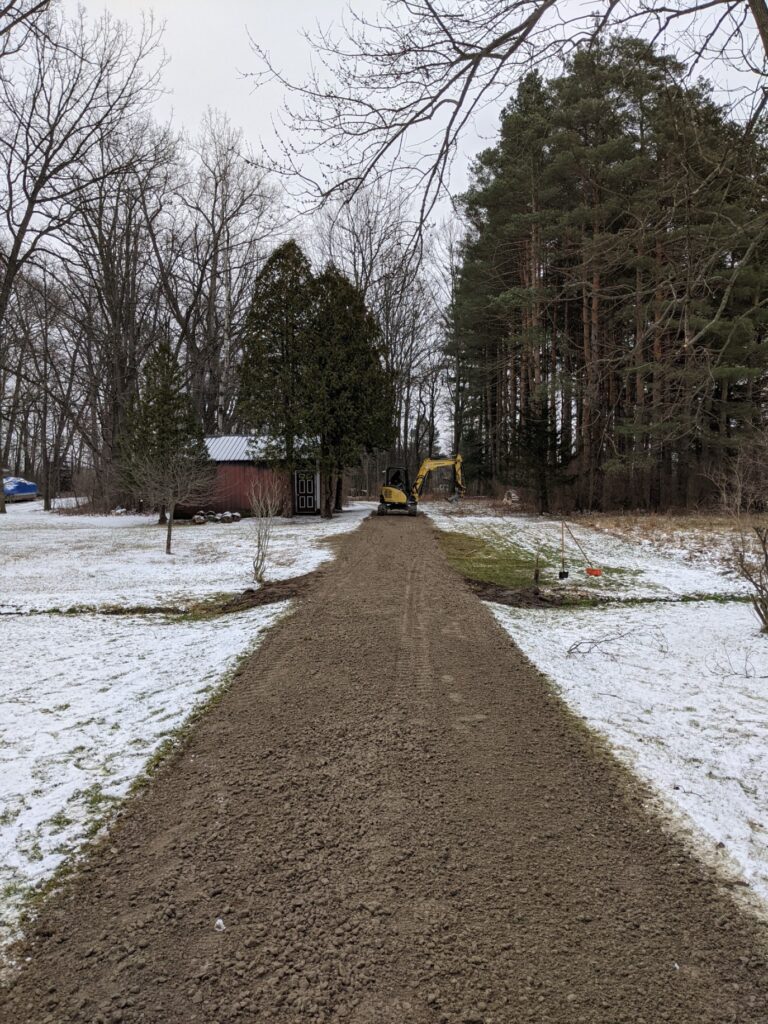
A driveway has one quiet job besides carrying your truck: getting water off itself fast. Every puddle that sits is a spot that will soften, rut, and — come winter — freeze and lift. John grades every driveway around Fenton with that in mind, because the slope built into a surface is half of what makes it last. The other half is the base, and the two work together. Get the grade right and water leaves on its own, no maintenance required.
The slopes that move water
Water moves because of pitch, and a good driveway has it built into more than one direction:
- Crown: A driveway crowned down the center sheds water to both edges, like a road. This is the workhorse for straight, level-ish runs.
- Cross-slope: On a drive that hugs a hillside, a single cross-pitch sends water to the low side where it can be carried away.
- Longitudinal slope: The fall along the length of the drive, which moves water toward a ditch, culvert, or low point rather than toward your garage or house.
The right combination depends on the lot. A drive that runs downhill toward a garage needs special attention so water doesn't follow the slope straight to the foundation. A drive that's nearly level needs a deliberate crown built in, because flat ground gives water no reason to leave on its own. And a drive that bends has to carry its pitch through the curve so a low spot doesn't form right where vehicles turn. That's where reading the site matters more than any rule of thumb — every driveway moves water a little differently, and the grade has to match the ground it's built on.
Where the water has to go
Pitching the surface only helps if the water has somewhere to land. A driveway that drains beautifully into a flat, clay-bottomed yard just moves the puddle a few feet. So grading the drive is really grading the whole approach:
- Roadside ditches that carry runoff away along the property line.
- A culvert where the drive crosses a ditch, sized so water keeps flowing under the entrance instead of backing up.
- Swales and shaped grade alongside the drive that lead water to a safe outlet.
- Pitch away from the house and garage at every point, so the structure stays dry.
This is why a driveway and the surrounding earthwork are really one job. We grade the drive and the ground around it as a system so water has a clear, intended path off the property.
Why it matters more here
In our climate, standing water isn't just a nuisance — it's the mechanism that destroys driveways. Clay soil holds it, cold weather freezes it, and the expansion lifts and cracks whatever sits on top. Then the thaw drops everything unevenly. A drive that sheds water before it can sit takes the freeze-thaw cycle out of the equation. That's the whole game in Michigan: don't let the water stay long enough to freeze where it can do damage.
Frequently asked
What slope does a driveway need to drain?
Enough pitch to move water without making the drive feel steep or scour the surface in heavy rain. The exact amount depends on length, surface, and where the water needs to go — John sets it by reading the site, not a single number.
My driveway slopes toward my garage. What can be done?
A drive that falls toward a structure needs a trench drain, a regraded approach, or a swale to intercept water before it reaches the building. We've fixed plenty of these; it starts with reading where the water actually goes.
Can you fix drainage without rebuilding the whole driveway?
Sometimes. If the base is sound, regrading the surface and shaping the surrounding ground may be enough. If the base is gone, it's a rebuild. The walk-through tells us which.
Does grading a gravel drive differ from a paved one?
The principle is identical — both need pitch to shed water. A gravel or millings surface lets you regrade more easily over time, which is one of its quiet advantages.