Fixing a Driveway That Never Drained Right
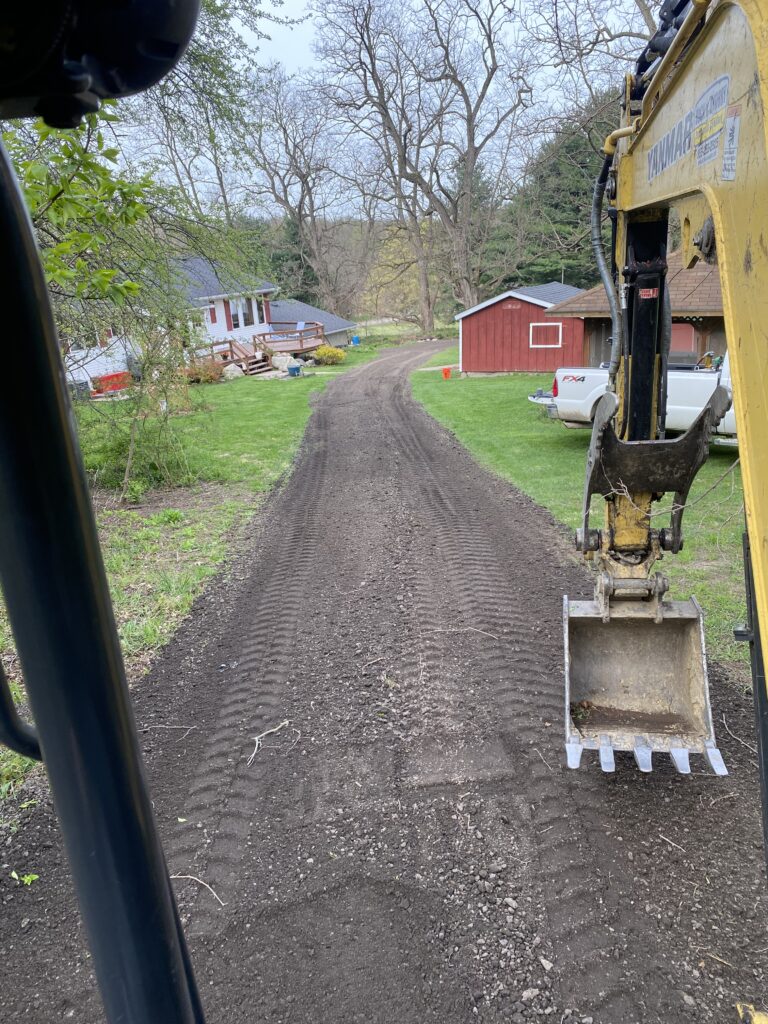
Some driveways never worked from the day they went in. The puddles show up in the same spots after every rain, the ruts come back no matter how much stone gets thrown at them, and by February the whole thing is ice. When John gets called out to one of these around Genesee or Oakland County, the conversation isn't about the surface — it's about why the water has nowhere to go. Fixing it means finding that out first.
Why it never drained
A driveway that has puddled since day one usually has one or more of these problems baked in:
- No pitch built into the surface. If it was laid flat, water has no reason to leave and just sits where it lands.
- Slope toward a low point or the house. Water follows the fall, and if the fall leads to a dead end or a structure, that's where it collects.
- No outlet. The drive may be pitched fine, but if the water arrives at a flat, clay-bottomed area with nowhere to go, it just spreads and sits.
- A failed or missing base. Soft, uncompacted ground holds water like a sponge and keeps the surface from ever firming up.
- A clogged or missing culvert. Where a drive crosses a ditch, a blocked or absent culvert backs water up onto the entrance.
The "throw more gravel at it" approach fails because it treats the symptom. New stone on a flat, base-less drive puddles right along with the old.
How we diagnose it
John reads the site the way water does. That means walking it — ideally after a rain, or imagining where the rain went — to see where water enters, where it pools, and where it's trying to escape. From there:
- We check whether the surface has any real pitch or was laid flat.
- We look at where the drive falls and whether that leads anywhere useful.
- We find the intended outlet — a ditch, culvert, or low area — and whether it's working.
- We probe the base and subgrade to see if the ground itself is the problem.
That picture tells us whether this is a regrade, a drainage add, a base rebuild, or some combination.
What the fix usually involves
The right fix depends on what's broken, but the work falls into a handful of moves:
- Regrading the surface to build in crown or cross-slope so water sheds.
- Cutting swales or shaping the approach to give water a path to a real outlet.
- Adding or clearing a culvert at the road crossing so the ditch keeps flowing.
- Rebuilding the base where the ground is soft, including fabric under the stone if the subgrade is wet.
- Tying into surrounding drainage so the water leaves the property, not just the driveway.
Done together, these take the freeze-thaw cycle out of play. Water that sheds before it can sit can't freeze where it does damage.
Frequently asked
Why does my new gravel keep disappearing into ruts?
The stone is sinking into soft, wet subgrade or washing out of a low spot that never drained. Adding more won't hold until the base and grade are corrected underneath it.
Can a poorly draining driveway be fixed without a full rebuild?
Often, yes. If the base is sound and the issue is grade or a missing outlet, a regrade and drainage work can solve it. A failed base means a rebuild. The walk-through decides.
Will fixing the driveway help my icy winter problem?
Yes — most driveway ice is standing water that froze in place. Move the water off the surface and you remove most of the ice with it.
Should drainage and the driveway be fixed at the same time?
Almost always. The driveway and the ground around it move water as one system, so it's far more effective to grade and drain them together than to fix one and leave the other.