Segmental Block vs. Boulder vs. Natural Stone Retaining Walls
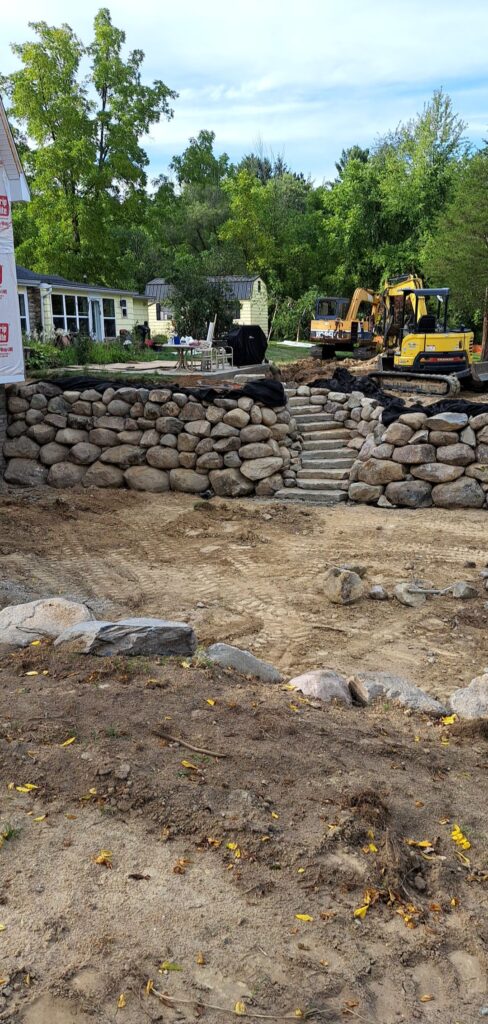
There's no single best retaining wall — there's the right one for your slope, your load, and your setting. We build all three common types, and the choice usually comes down to how much elevation you're holding back, how the wall will look, and what the site will let us do. Here's how we think it through.
Segmental Block
Segmental block walls are the engineered workhorse. They're made of manufactured concrete units designed to lock together, and for taller walls they tie into geogrid reinforcement buried in the backfill. That makes block the go-to when you're holding back serious height and load, or when a wall needs to carry a driveway or structure above it.
- Strong, predictable, and engineered for height and load
- Accepts geogrid reinforcement for tall walls
- Clean, uniform look that suits modern and traditional homes
- Repeatable units make a long, straight run straightforward
Because the units are consistent and the systems are designed to a known strength, block is also the easiest type to engineer with confidence when a wall gets tall. That predictability is a real advantage on a job where the wall is doing heavy structural work rather than just edging a garden bed. The trade-off is that a block face reads as manufactured — which looks great on some homes and out of place on others.
Boulder and Natural Stone
Boulder walls use large fieldstone or quarried rock stacked and set with heavy equipment. They look rugged and natural, drain well between the stones, and fit lake-country and wooded lots where a manufactured face would look out of place. They're excellent for slopes and shorelines and tend to handle ground movement gracefully. Because the stones are large and the gaps between them let water pass, a boulder wall is forgiving in wet settings where a tighter wall would have to work harder to drain.
Natural stone walls — whether dry-stacked or set with a tighter fit — give the most timeless, high-end look. They take skilled hands to build well, but nothing matches real stone for character. Every stone is read and placed individually, which is why good stonework is labor-intensive and why no two walls come out quite the same. Both boulder and natural stone rely on the same fundamentals as block: a solid base and drainage so water and frost don't work them loose over the years.
Whichever way we go, the structure behind the face matters more than the face itself. A beautiful stone wall set on poor ground fails just as fast as a cheap one. The setting usually points the way — a wooded or lakefront lot leans toward boulder or stone, a clean modern yard or a tall structural wall leans toward block — but the load and the height have the final say.
Frequently asked
Which type lasts the longest?
All three last when they're built right, because longevity comes from the base and drainage, not the material. Block gives the most engineered strength for tall walls; boulder and stone are extremely durable and age well. John matches the type to your site so it holds for the long haul.
Which one looks best?
That's personal, but generally: natural stone reads high-end and timeless, boulder looks rugged and natural for lake and wooded lots, and block looks clean and uniform. We'll show you what fits your home and setting during the walk-through.
Is one cheaper than the others?
Costs depend on height, length, access, and material, so we don't quote a type sight unseen. Block is often efficient for long, tall runs; stonework is labor-intensive. John gives you a written estimate after seeing the site.
Can you mix materials?
Yes. We sometimes pair a structural block wall where it carries load with stone or boulder accents where it's most visible. The right combination depends on the job.